Election years change the operating environment for House offices in ways that have little to do with politics and everything to do with time, compliance, and capacity.
From the outside, constituents expect continuity; casework still needs attention, District issues still demand explanation, work at federal agencies does not pause. From the inside, however, the calendar tightens, communications windows narrow, and staff are asked to do more with less — often earlier in the year than anticipated.
A strong election-year communications plan doesn’t aim for perfection. It focuses on clarity, continuity, and credibility, recognizing the realities House offices face and planning accordingly.
1. The Election-Year Shift: Same Mission, Tighter Margins
For House offices, election pressure arrives early and intensifies quickly. Members are more visible in their districts, travel increases, and schedules become less predictable. Staff bandwidth tightens even as constituent expectations remain unchanged.
The communications mission itself does not shift:
- Keep constituents informed
- Explain official actions and resources
- Maintain accessibility and responsiveness
What changes is how and when that mission can be executed.
Effective election-year planning assumes:
- Fewer clean opportunities for mass outreach
- Less tolerance for last-minute pivots
- Greater reliance on systems, templates, and repeatable processes
In this environment, planning is not about ambition — it is about resilience.
2. Compliance Drives the Calendar (Earlier Than Many Expect)
One of the most significant operational constraints for House offices in an election year is the communications blackout period.
Communications restrictions begin 90 days before each state’s primary elections, not just the general election in November. For many House districts, this means broad outreach opportunities close far earlier than anticipated — particularly in states with early or multiple primaries.
These restrictions affect:
- Newsletters and mass mail
- Broad digital outreach
- District-wide proactive messaging
Practical recommendation:
Early in the year, offices should build a shared compliance calendar that:
- Maps all relevant primary dates
- Clearly marks blackout start and end points
- Distinguishes between proactive and reactive communications
- Is shared across communications, legislative, scheduling, and district teams
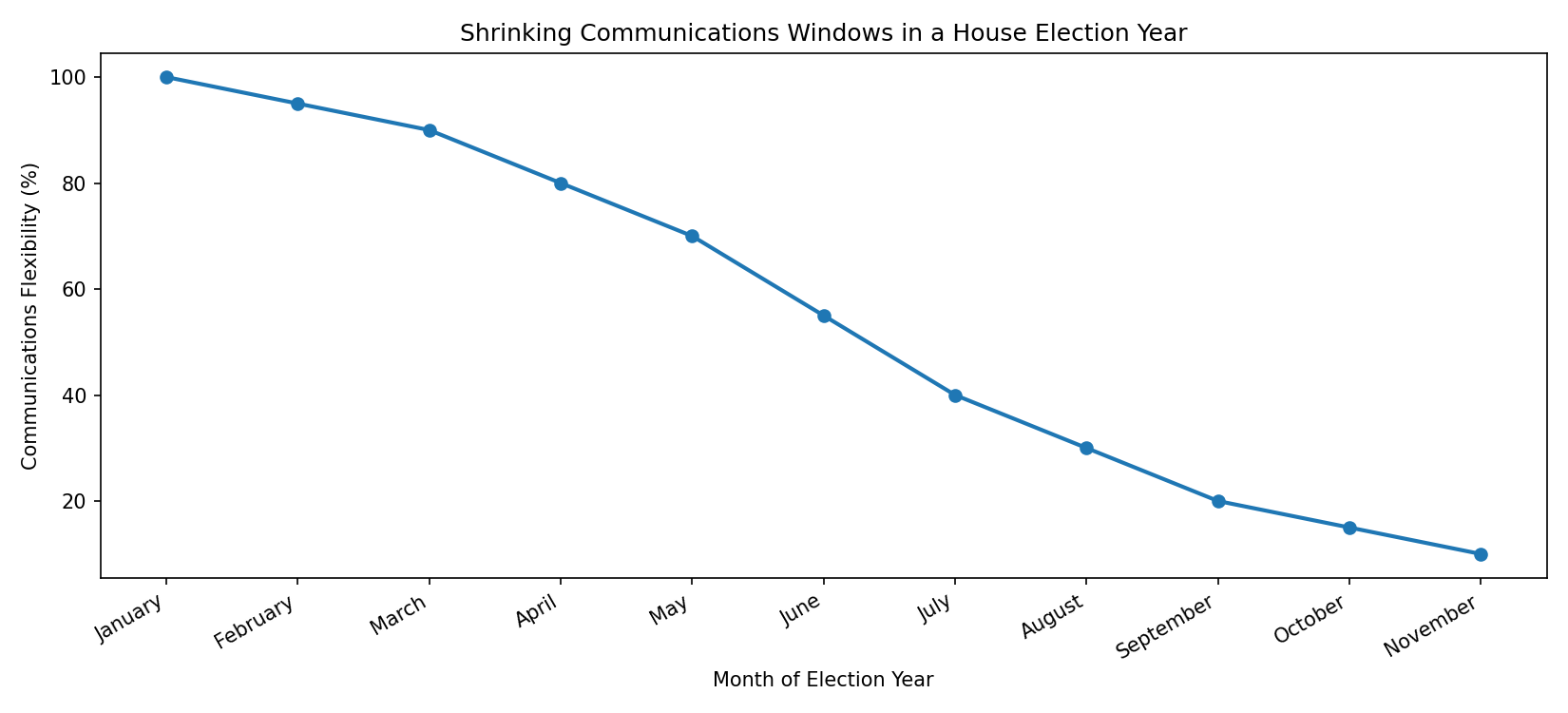
When everyone understands when windows close, planning becomes proactive rather than reactive. We ran some conceptual analytics on the compressed communications windows the House faces as an overall institution. Here’s what we found:
3. Front-Load What Matters Most
Because communications windows are limited, the most effective House offices front-load proactive outreach when flexibility is greatest.
Early-year communications often focus on:
- District-specific legislative impact
- Federal programs and resources available locally
- Casework outcomes that demonstrate responsiveness
- Educational content that explains how constituents can engage with the office
This content does more than inform. It builds a foundation that later communications can reference without repeating.
As blackout periods approach, communications naturally narrow toward:
- Constituent services
- Office accessibility
- Official updates that clearly meet compliance standards
This shift is not a failure of planning; it is the result of planning well.
4. District Focus Is a Strategic Advantage
House offices benefit from proximity to the public. Constituents often recognize the Member, know the district offices, and interact directly with staff. That familiarity allows communications to be more targeted and more practical.
Strong election-year plans lean into this advantage by:
- Segmenting outreach geographically or by issue
- Coordinating district office messaging with DC activity
- Treating casework communications as a core part of the overall strategy
Maintaining accurate, centralized constituent data becomes especially important when time and staffing are constrained. Offices that can quickly understand who they’ve communicated with — and about what — are better positioned to stay compliant while remaining responsive.
5. Franked Mail Remains a Valuable Tool
While digital channels dominate day-to-day communications, franked mail continues to play an important role for House offices — particularly in election years.
Its strengths are practical:
- A well-defined compliance framework
- Broad reach within the district
- High perceived legitimacy as official communication
When used thoughtfully, franked mail works best as part of a coordinated plan:
- Scheduled well ahead of blackout periods
- Focused on constituent education and services
- Reinforced by digital and district office outreach
Rather than viewing franked mail as a standalone tactic, effective offices treat it as one element within a broader communications ecosystem.
6. Plan for Staff Transitions Before They Happen
Election years frequently bring staffing changes. Communications responsibilities may shift temporarily or permanently as staff support campaign activity or transition to new roles.
To maintain continuity, offices benefit from:
- Documented approval and review workflows
- Shared message archives and templates
- Clear guidance embedded in daily tools
- Centralized systems that preserve institutional knowledge
When transitions occur, these preparations reduce risk and preserve momentum.
7. Tools Should Reduce Risk, Not Add Complexity
In high-pressure periods, communications tools should retreat from the forefront and run seamlessly in the background. Staff should be able to focus on judgment and execution, confident that systems support compliance, coordination, and continuity.
Capabilities that matter most in election years include:
- Unified tracking across DC and district offices
- Clear communication histories
- Audience segmentation aligned with district realities
- Role-based access that supports staff changes
When systems are designed for government workflows, they help offices move faster without cutting corners.
8. Credibility Is the Goal
In an election year, visibility is easy to chase. Credibility is harder to maintain.
The strongest House offices are not necessarily the loudest. They are the ones that:
- Communicate clearly and consistently
- Respect compliance boundaries
- Stay responsive to constituent needs
- Do not speculate on future outcomes that are unknowable
- Align staff expectations with operational reality
A thoughtful election-year communications plan does not just guide outreach. It equips staff to advise the Member with confidence, realism, and foresight. Are you ready to work with one of our specialists to develop your comms roadmap for the rest of this year? We’re offering complimentary strategy sessions with no obligations to any House offices who would like a consultation. Reach out to schedule yours.